
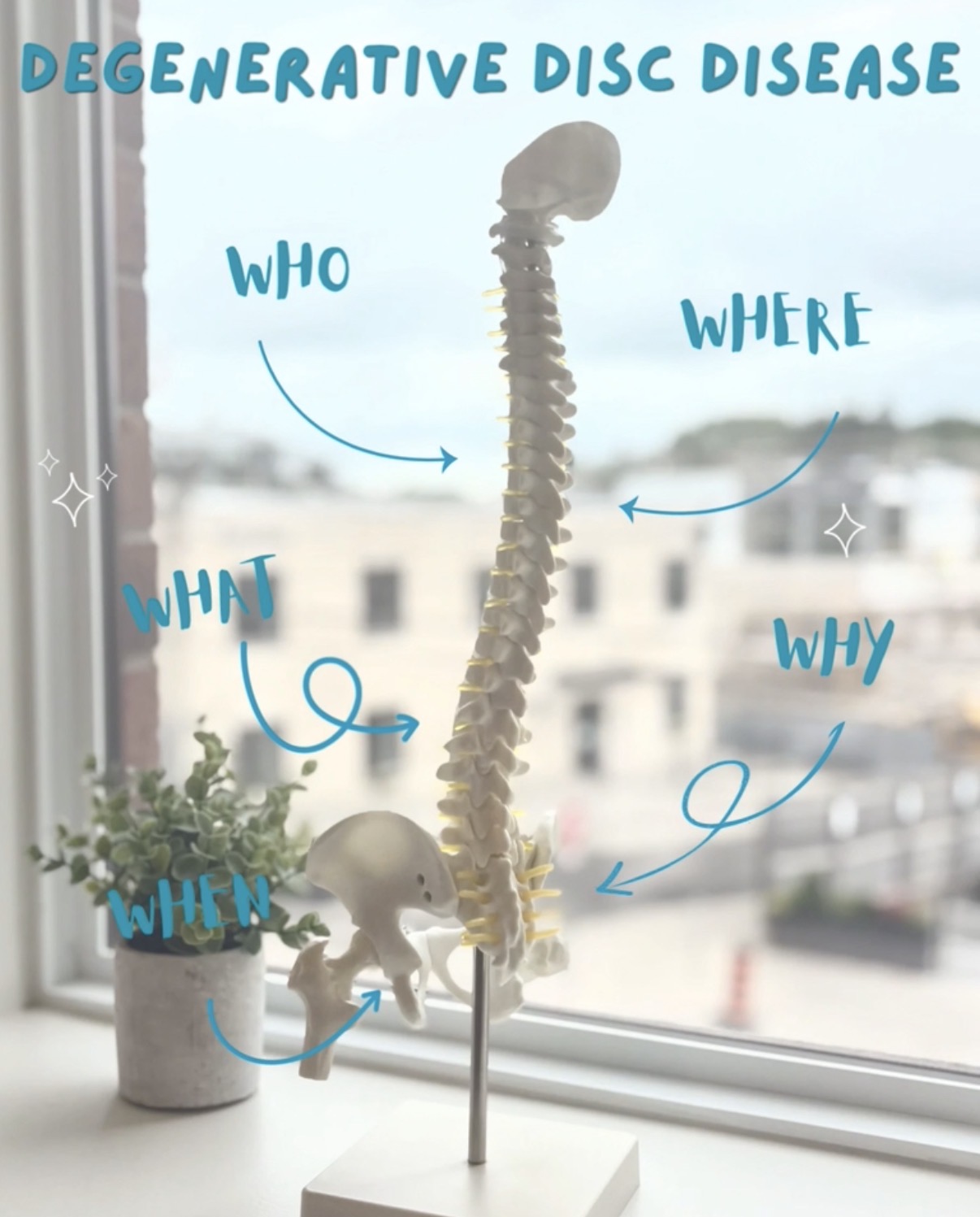
Degenerative disc disease is not really a disease, but a condition that impacts the discs in the spine.
Our spine consists of bones (called vertebrae) and intervertebral discs that sit between each vertebra. This disc is like a cushion, made up of:
- The annulus fibrosus: the fibrocartilage exterior that helps to hold the disc’s structure
- The nucleus pulposus: the gelatinous inner portion of the disc that helps with shock absorption and flexibility of the spine
Due to aging, repetitive activity, and genetics, anyone can develop degenerative changes including:
- Loss of water content in the disc, making it more difficult to absorb shock
- Loss of structure and fissures in the different layers of the disc
- Potential bulging of the nucleus pulposus into the other layers of the disc
- Formation of bone spurs in the spine
These changes are not inherently bad and are often considered part of the aging process, just like we get wrinkles in our skin as we age. For some people, however, these changes may contribute to their pain experience.
Some individuals who are experiencing symptoms might report:
- Neck or lower back discomfort and stiffness
- Nerve symptoms like radiating pain, tingling, or numbness in the arm or leg, as well as possible weakness in the limb
- Symptoms that are sensitive to certain movements or sustained postures
WHO gets it:
Anyone and everyone!
Degenerative changes in the spine are a completely normal part of aging, however not everybody who has these changes on imaging has any symptoms at all.
Many individuals with disc degeneration have no pain, and many individuals with severe low back or neck pain have minimal degenerative changes on imaging.
WHEN does it show up:
Imaging studies show:
- At 20 years of age, 37% of people with no symptoms will show degenerative changes on imaging
- At 80 years of age, 96% of people with no symptoms will show degenerative changes on imaging
- Disc bulges specifically show up in 30% of asymptomatic 20-year-olds and 84% of asymptomatic 80-year-olds
- Progression of degeneration on imaging is not necessarily correlated with future pain – so your findings on X-ray or MRI may progress, but that does not mean you will have pain going forward
What does all of this mean? Often, people won’t even know that they have these changes in their spine as they are not experiencing pain! These changes develop over time, so they are not typically associated with a specific event or injury.
WHERE does it occur:
Because we have discs throughout our spine, degenerative changes can occur anywhere along it. These changes tend to be more prevalent in the neck and low back, as these areas are more mobile and exposed to greater forces over time.
Our mid back, known as our thoracic spine, tends to be more rigid as it attaches to the ribcage, making this area less susceptible to the same type of changes.
WHY isn’t it getting better:
The reality is, once these changes occur, they cannot be reversed. The discs of our spine naturally get more dehydrated as we age. They also have a limited blood supply, which reduces their capacity for healing.
But that doesn’t necessarily mean that you have to be in pain!
HOW can I fix it:
You can’t fix degenerative disc disease, but if you are experiencing low back or neck symptoms that you think may be related to it, there are many ways that physiotherapy can help.
Because findings on imaging do not determine symptoms, treatment for chronic back and neck pain should focus less on “fixing” the spine, and more on:
- Building strength and endurance
- Progressive exposure to aggravating activities
- Reducing disability
- Improving confidence in day-to-day activities
Research shows:
- Compared with no treatment, regular exercise improves pain and disability in those with chronic low back pain
- No single type of exercise is superior: walking programs, aerobics, aquatic therapy, core strengthening and mobility exercises are all excellent options for improving pain and function
- Exercise is generally more effective than many passive treatments alone
Degenerative disc changes are a normal part of aging, and while they can sometimes contribute to pain, staying active and engaging in regular exercise remains one of the most effective ways to manage symptoms and maintain function over time.
Sources:
Aali S, Rezazadeh F, Imani F, Nabati Sefidekhan M, Badicu G, Poli L, et al. Effects of exercise-based rehabilitation on lumbar degenerative disc disease: a systematic review. Healthcare (Basel). 2025 Aug 7;13(15):1938. doi:10.3390/healthcare13151938
Brinjikji W, Luetmer PH, Comstock B, Bresnahan BW, Chen LE, Deyo RA, et al. Systematic
Literature Review of Imaging Features of Spinal Degeneration in Asymptomatic Populations. Spine (Phila Pa 1976). 2015 Apr 1;40(11):811-816. doi: 10.1097/BRS.0000000000000915.
Scarcia L, Pileggi M, Camilli A, Mangiola A, Sestili C, Cotellese R, et al. Degenerative Disc Disease of the Spine: From Anatomy to Pathophysiology and Radiological Appearance, with Morphological and Functional Considerations. J Pers Med. 2022 Nov;12(11):1810. doi: 10.3390/jpm12111810
Zaina F, Tomkins-Lane C, Carragee E, Negrini S. Surgical versus non-surgical treatment for lumbar spinal stenosis. Cochrane Database Syst Rev. 2016 Jan 29;2016(1):CD010264. doi: 10.1002/14651858.CD010264.pub2