
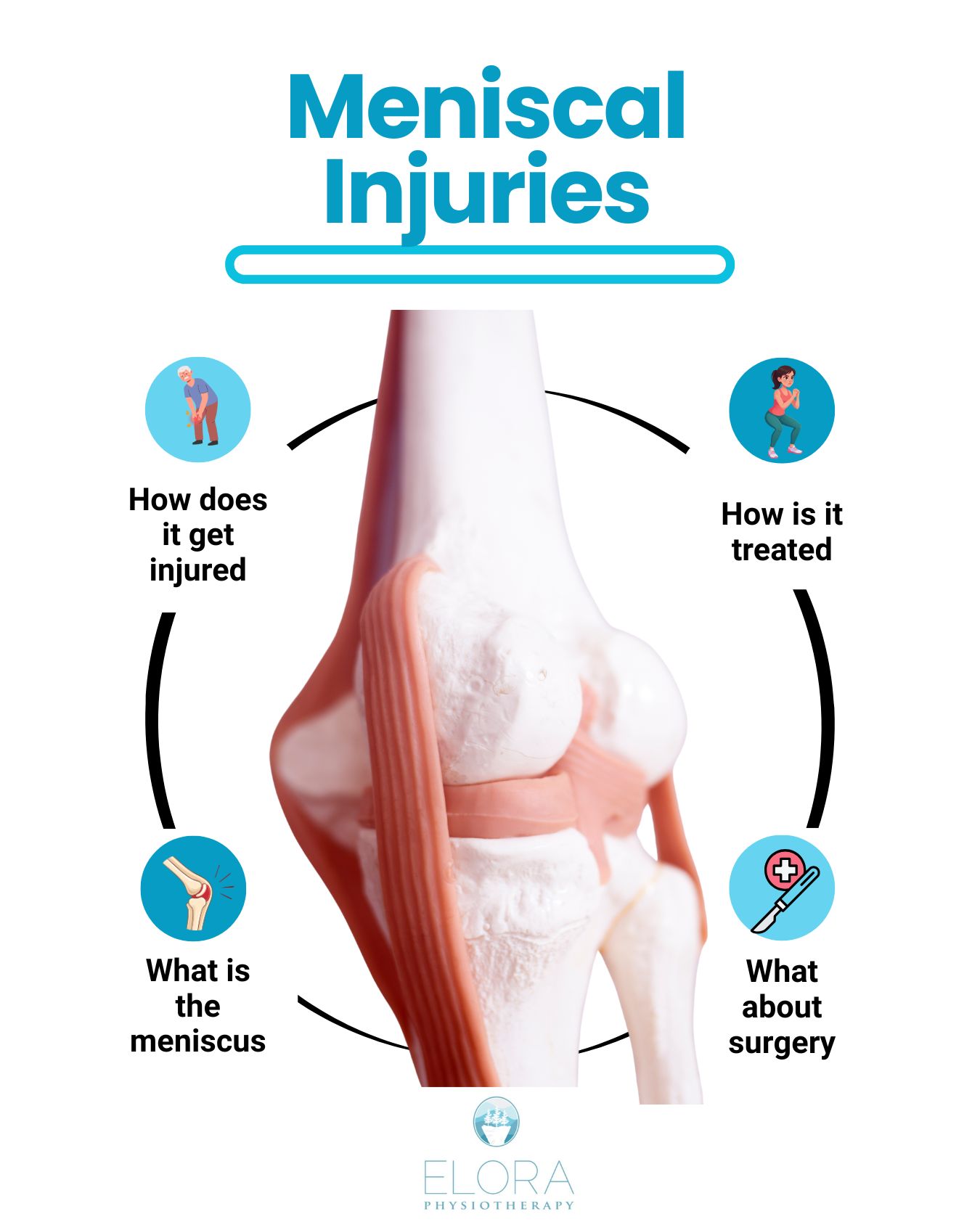
You’ve probably heard of the ACL, but there are many other important structures in the knee – and today we are talking about a big one…..the meniscus!
What is the meniscus?
Each knee joint has two menisci. These sit on top of your tibia (shin bone) and play an important role in:
- Stabilizing the knee by controlling translation and rotation
- Shock absorption during weight bearing and impact activities
The medial meniscus on the inside of the knee is a C shape, while the lateral meniscus on the outside of the knee is more of an O shape. These menisci function differently, with the medial meniscus having less mobility and being more prone to injury as a result.
Because of their role as shock absorbers, any injury to these tissues can lead to increased risk of degeneration in the joint, contributing to osteoarthritic changes over time. The potential for healing of the meniscus varies depending on the location and size of the tear, as the inner part of the meniscus does not have good blood supply and has a harder time recovering.
How does it get injured?
Because of its role in controlling translation and rotation, either of these forces can result in injury to the meniscus. This includes movements like a twist while your foot is planted on the ground, an impact like landing a jump, or a forceful squatting motion.
In addition, a direct impact like a tackle, car accident, or a fall can result in injury to the meniscus. Often times, meniscus injuries can also be degenerative in nature, meaning as the tissue ages or is exposed to repetitive strain, it is more susceptible to irritation.
What are the treatment options?
Typically when someone suffers a meniscal injury, the first line treatment is…physiotherapy! Research shows physiotherapy has good success rate when it comes to patient rating of both pain and function.
Physiotherapy for a meniscal tear typically consists of:
- Education regarding activity modification and self management
- Pain and swelling management
- Mobility and early loading of the knee
- Strengthening of the hip and ankle to help support the knee
- Functional training and return to activity
The amount of physiotherapy needed for a non-operative meniscal injury can vary depending on the tear, taking anywhere from a few weeks to several months for more severe injuries.
Sometimes cortisone injections are used alongside physiotherapy treatment. These injections can be useful to help break the inflammatory cycle, providing temporary pain management and thereby allowing participation in an active therapy program. Pain management can also include over the counter or prescription medications to help support recovery in early stages when pain and swelling are more pronounced.
Why can’t I just have surgery?
Surgery for the meniscus usually consists of an arthroscopy- a minimally invasive procedure where the injured meniscus is either repaired or the torn pieces are removed. Following surgery, physiotherapy is often required to maximize recovery.
Researchers have studied the outcome of surgery by comparing a partial meniscectomy to a sham surgery – where no changes were made to the knee joint. The results demonstrated that patients in the surgical group did not have a greater improvement in terms of pain or quality of life than those in the sham group, although both groups demonstrated significant improvements at both 2, 6, and 12 months post-op.
Another study compared surgery vs physiotherapy for individuals with degenerative tears of the meniscus. At both 6 and 12 months post surgery/treatment, as well as long term, both groups demonstrated similar outcomes in terms of function. In fact, the evidence showed that often physiotherapy patients can avoid surgery entirely; research studies like this support the current best practice of physiotherapy being the first line and preferred treatment for most meniscal tears.
Sources:
Mameri ES, et al. Review of Meniscus Anatomy and Biomechanics. Curr Rev Musculoskelet Med. 2022 Oct;15(5):323-35. doi: 10.1007/s12178-022-09768-1.
Sihvonen R, Paavola M, Malmivaara A, Itala A, Joukainen A, Nurmi H, et al.; Finnish Degenerative Meniscal Lesion Study (FIDELITY) Group. Arthroscopic Partial Meniscectomy versus Sham Surgery for a Degenerative Meniscal Tear. N Engl J Med. 2013 Dec 26;369(26):2515-24. doi: 10.1056/NEJMoa1305189.
Katz JN, Brophy RH, Chaisson CE, de Chaves L, Cole BJ, Dahm DL, et al. Surgery versus Physical Therapy for a Meniscal Tear and Osteoarthritis. N Engl J Med. 2013 May 2;368(18):1675-84. doi: 10.1056/NEJMoa1301408.
Noorduyn JCA, van de Graaf VA, Willigenburg NW, Scholten-Peeters GGM, Kret EJ, van Dijk RA, et al. Effect of Physical Therapy vs Arthroscopic Partial Meniscectomy in People With Degenerative Meniscal Tears: Five-Year Follow-up of the ESCAPE Randomized Clinical Trial. JAMA Netw Open. 2022 Jul 1;5(7):e2220394. doi: 10.1001/jamanetworkopen.2022.20394.